Artificial intelligence (AI) is changing how businesses work, from automating routine tasks to helping teams analyse information, create content, and improve customer experiences.
For small and medium-sized enterprises (SMEs), AI doesn't have to mean a major technology investment or a complete overhaul of how you work. You can start small, using AI to solve a specific business problem, save time, or help your team work more efficiently.
AI for small businesses
AI can help small businesses automate routine work, analyse information, support customer service, and create marketing content. You don't need a large budget to get started. Many businesses can begin with free tools, while paid AI assistants can typically cost around £10–£25 per user per month, depending on the tool and features you choose.
The key is to start with a specific problem, test whether AI can help, and build from there.
What routine work can AI automate today?
One of the simplest ways for a small business to start using AI is to reduce the amount of time spent on repetitive work.
AI tools can help you:
- draft and respond to routine emails
- create or rewrite product descriptions
- summarise documents and meeting notes
- turn notes into first drafts
- organise information
- create social media posts
- generate ideas for marketing campaigns
- answer common customer questions.
For example, you could give an AI tool a product description and ask it to create a shorter version for your website, an email introduction, and a social media post.
Tools powered by natural language processing (NLP) can help with many of these tasks. They may be built into software you already use, or available through standalone applications such as ChatGPT.
AI shouldn't replace human review, particularly when you're communicating with customers. Always check AI-generated content for accuracy, tone, and relevance before using it.
How can AI improve stock and supply decisions?
Running a small business often means making decisions based on lots of different pieces of information.
AI can help analyse data and identify patterns that might otherwise take considerable time to spot. Depending on the systems you use, this could include looking at:
- sales trends
- stock levels
- customer demand
- supplier information
- purchasing patterns
- operational performance.
For example, analysing historical sales data could help you identify products that regularly sell more at particular times of year. You could then use those insights to inform stock planning.
AI doesn't replace business judgement, but it can make it easier to find useful information and explore different scenarios.
Data and technology skills can also help employees identify opportunities to improve business processes. For example, learners on a Data and Technology apprenticeship may explore how AI can be used to improve processes, including building applications that can help filter customer calls before they reach a call centre agent.
How can AI help with coding and software development?
If your business develops software, AI coding assistants can help developers write, review, explain, and debug code.
AI can:
- suggest code based on a description of what you want to achieve
- identify potential errors
- explain unfamiliar code
- suggest ways to improve existing code
- help create tests and documentation.
These tools are increasingly integrated into development environments, so developers can work with AI without constantly switching between applications.
However, AI-generated code still needs to be reviewed and tested. It can contain errors, introduce security vulnerabilities, or fail to work as expected.

How can AI personalise customer experiences?
Personalisation can be time-consuming when you're running a small business, particularly when you're trying to communicate with lots of customers.
AI can help you create more targeted marketing content, product recommendations, and communications.
For example, you could use AI to adapt an existing campaign for different customer groups, or generate several versions of an email for different audiences.
You can even try this with an existing campaign. Give the AI tool your original content and ask it to suggest ways to adapt it for a particular audience.
However, make sure you're using customer data responsibly and following relevant data protection and privacy requirements.
How can AI summarise documents and information?
Long reports, research papers, meeting transcripts, and other documents can take a lot of time to read.
AI tools can summarise documents, identify key points, and answer questions about their contents. This can be particularly useful when you need to understand a document quickly before deciding what action to take.
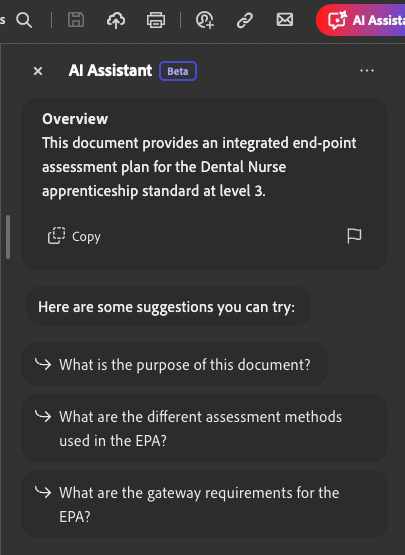
Tools such as ChatGPT and Adobe Acrobat can help summarise documents and answer questions about their contents.
As with any AI-generated output, check important information against the original document rather than relying on a summary alone.
What are the risks of using AI in a small business?
AI can save time and create new opportunities, but it isn't something businesses should adopt without thinking about the risks.
Will AI replace my employees?
AI can automate certain tasks, but that doesn't necessarily mean it will replace entire jobs.
For a small business, a more useful question may be: which parts of our employees' work could AI help with?
An employee might use AI to summarise information, draft content, analyse data, or automate a repetitive process, while still making the decisions that require human judgement, creativity, and experience.
AI is therefore likely to change how many people work, rather than simply removing the need for people.
I grew up in the 1980s when there was a fear of the calculator. AI is another technology that businesses and employees will need to learn how to use effectively.
What are low-cost ways to start using AI?
You don't need a huge budget to start experimenting with AI.
A useful way to think about your options is in three tiers.
Free: £0 per user
Many AI tools offer free versions or features at no additional cost.
You could use these for:
- brainstorming
- drafting and rewriting content
- summarising shorter documents
- generating ideas
- basic research and question answering.
This is a sensible starting point if you want to experiment before committing to a paid tool.
Entry-level: around £10–£25 per user per month
Paid AI assistants can provide higher usage limits and additional features. Some can also be integrated directly into software your business already uses.
At this level, AI could potentially help with:
- email and document assistance
- content creation
- meeting and information summaries
- spreadsheet and data analysis
- customer communications
- productivity tasks.
The exact features available will depend on the tool and your existing software subscriptions.
Moderate spend: £25+ per user per month
More advanced requirements may justify additional investment, particularly where AI needs to work with business data, integrate with existing systems, automate workflows, or support larger teams.
This could include:
- advanced data analysis
- workflow automation
- AI connected to internal business information
- custom AI applications
- more sophisticated customer service tools.
At this point, consider the business problem you're trying to solve and the potential return before buying additional tools.
The key takeaway is: don't buy AI because you feel you should. Start with a specific problem, test a solution, and measure whether it saves time, reduces costs, or improves the customer experience.
What AI tools could my business use?
There are many free and paid AI tools available, including general-purpose tools such as ChatGPT, Microsoft Copilot, and Google Gemini.
The right tool will depend on what you're trying to achieve. A general-purpose AI assistant may be enough for drafting content or summarising information, while more advanced requirements may call for specialist software or integrations.

How can different people in my business use AI?
AI won't be useful in exactly the same way for everyone. Different teams can use it to support different tasks.
What can AI do for business owners and operations teams?
Three areas to explore are:
1. Analyse sales or operational data to identify trends and patterns.
2. Summarise reports and business information to make it easier to identify key points.
3. Identify repetitive processes that could potentially be automated.
Starter prompt:
I'm a small business owner. Here is a description of our current process: [insert process]. Identify the repetitive steps, explain where AI or automation could help, and suggest three ways to improve the process.
What can AI do for customer support?
Three useful starting points are:
1. Draft responses to common customer enquiries.
2. Summarise customer conversations so key information is easier to review.
3. Create FAQs based on recurring customer questions.
Starter prompt:
Here are 20 common customer questions and our existing answers. Group them into themes and suggest an FAQ structure that would help customers find answers quickly. Don't invent information that isn't included.
What can AI do for marketing?
Marketing teams could use AI to:
1. Adapt existing content for different channels and audiences.
2. Generate campaign ideas based on a particular objective.
3. Develop different versions of marketing messages for specific customer groups.
Starter prompt:
Here is our existing marketing campaign: [insert campaign]. Suggest three ways to adapt it for [audience/channel]. Keep the tone [describe tone] and don't introduce claims that aren't supported by the original content.
What can AI do for finance teams?
AI can help finance teams work with information and identify trends.
Three potential uses are:
1. Summarise financial information.
2. Identify trends and unusual changes in business data.
3. Prepare questions for financial reviews and planning discussions.
Starter prompt:
Here is a summary of our financial data: [insert data]. Identify the main trends, unusual changes, and questions a small business owner should consider. Don't make assumptions about missing information.
Remember: don't put confidential, personal, financial, or commercially sensitive information into an AI tool unless you're confident the tool and your organisation's policies allow you to do so.
How should a small business adopt AI?
You don't need to transform your entire business overnight. A phased approach can help you test what's useful before making bigger investments.
Your first 30 days: experiment
Start by identifying repetitive tasks that take up time.
Ask your team:
- What tasks do you do every week that feel repetitive?
- Where are you copying and pasting information?
- Which documents take a long time to create?
- What questions do customers ask repeatedly?
- Where do you spend time searching for information?
Choose one or two low-risk tasks and test an AI tool.
Goal: identify whether AI can save time or improve the quality of the work.
Days 31–60: test and measure
Once you've identified promising use cases, test them more systematically.
Decide:
- who will use the tool
- what information can be entered
- what needs human review
- how outputs will be checked
- how you'll measure success.
For example, if you're using AI to draft customer emails, measure how much time employees spend producing and reviewing responses before and after introducing the tool.
Goal: establish whether the tool is delivering a measurable benefit.
Days 61–90: scale what works
If a pilot has delivered useful results, consider expanding it.
You could:
- introduce the tool to more employees
- create internal guidance for using AI
- develop approved prompts
- identify additional use cases
- provide AI skills training
- establish rules around data, privacy, and human review.
If a test hasn't delivered a benefit, stop using it. Not every business problem needs an AI solution.
Goal: build AI into useful business processes rather than adopting technology for its own sake.
How can I build AI skills in my business?
The technology is changing quickly, so helping employees develop the skills to use it effectively can be just as important as choosing the right tools.
Training can help employees understand how AI works, where it can add value, how to write effective prompts, and where human judgement is still essential.
We offer a free generative AI course to apprentices on our Data and Technology programmes. This can help apprentices and the businesses they work for develop their understanding of generative AI and prepare for a workplace where AI is increasingly part of everyday working.
What does AI mean for the future of my small business?
AI isn't a single solution that will transform every part of your business overnight.
Instead, its value may come from lots of smaller improvements: reducing repetitive work, helping employees find information, supporting customer service, analysing data, and making it easier to create content.
The businesses that benefit from AI won't necessarily be the ones using the most tools. The important thing is understanding where AI can solve a genuine business problem, where human expertise is still needed, and how to use the technology responsibly.
Upskill your business today
If you're looking to develop your colleagues' and team's data, technology, and AI skills, your business could benefit from our Data and Technology apprenticeship programmes.