The ACCA MA (Management Accounting) exam is an essential step in every aspiring accountant’s professional development. But with a broad syllabus and tricky topics to cover, understanding how to effectively prepare can make all the difference.
Whether you’re sitting this exam for the first time or seeking a pass after a previous attempt, these insights will give you the tools needed to approach the MA exam with confidence.
What are the exam topics?
The ACCA MA exam is split into two sections, covering a wide range of topics in management accounting.
Section A features objective test questions. Each question in Section A is independent and tied to its scenario, testing your breadth of knowledge across the syllabus.
Topics will likely include:
- Theoretical aspects (eg, understanding cost classification and behaviour)
- Numerical tasks (eg, basic costing techniques, budgeting, and variance analysis).
Section B follows a scenario-based approach with objective test options. This section goes deeper into key topics, requiring a more comprehensive understanding and practical application of concepts.
The key areas tested will be:
- Budgeting
- Standard costing
- Performance measurement
Main study topics for the ACCA MA exam:
- Cost and management accounting techniques
- Budgeting and forecasting
- Standard costing principles
- Decision-making techniques (Relevant cash flows and Investment Appraisal)
- Performance measurement
By covering these topics in depth, you’ll be equipped for both the theoretical and application-based questions found in the exam.
How is the ACCA MA exam structured?
| Sections | Number of marks |
|---|
Section A
- 35 objective-test style questions
- Two marks per question
| 70 marks |
Section B
- Three questions
- 10 marks per question
| 30 marks |
During Section A, you will find traditional short questions. This includes multiple choice, multiple response, multiple response matching and number entry. Each question relates to its own scenario.
Section B will feature a series of tasks which relate to one or more scenarios. These are objective test questions with sub-requirements of multiple answer options.
The pass mark for the exam is 50%, so the best plan of action is to answer Section B first, then return to Section A. You can maximise your marks in Section B through the sequence of fill-in-the-blanks scenario questions. You also already know that each question in this section could test you on budgeting, standard costing, and performance management, so maximising your marks here will be the key to passing.
Timings
Aim for:
- 35 minutes - Section B
- 60 minutes - Section A
- 20 to 25 minutes - reviewing your answers
If the 35 minutes are up before you’ve finished Section B, still try to move to Section A to ensure you attempt all questions. Section A will test all wide syllabus areas, so it’s important to stay calm and answer every question before submitting your exam. If you’re struggling, flag the question and return to it later.
By splitting the time between 35 minutes and 60 minutes, you will give yourself 20 to 25 minutes to review all your answers for both sections.
How does the ACCA MA exam subject help my career and/or studies?
Management accounting is key if your dream career is to climb up the corporate ladder of becoming a management consultant or advisor. Understanding the basics of costing and investment appraisal will be useful as you progress through the ACCA qualification, particularly during the Financial Management (FM) and Performance Management (PM) subjects.
This subject will also build your reliability as an internal management accountant, as you may need to advise different key decision making areas within the industry. For example, understanding the difference between direct and indirect (overhead) costs will assist an organisation to apply a better cost-cutting approach, which will eventually help create a better profit-making approach.
Common challenges and tips for the ACCA MA and FMA exam
One of the tricky parts of studying ACCA MA is understanding the calculation of overhead absorption rates (OAR) and then the under or over absorption calculation.
During the exam, learners tend to struggle memorising the three steps of calculating any under or over absorption of overheads.
Step one - Calculate the OAR based on budgeted values, Step two - absorb the cost based on actual activity and Step three - compare the absorbed cost with the actual cost and state if there has been an under or over absorption. If absorbed is less than actual there has been an under absorption and if absorbed is greater than actual there has been an over absorption.
The ‘wrong answers’ in the MCQs will tend to be values calculated part way through the three steps so forgetting to do the final step of absorbing into the production unit can cost two marks in Section A.
Sometimes the question will ask for a ‘middle’ value and give you beginning and end values to work back from.
How to address these challenges
Try to learn the three steps and write them out in full when attempting an under or over absorption question. Fill in the numbers you are given and then work back and/or forwards to find the answer required.
Example question and answer
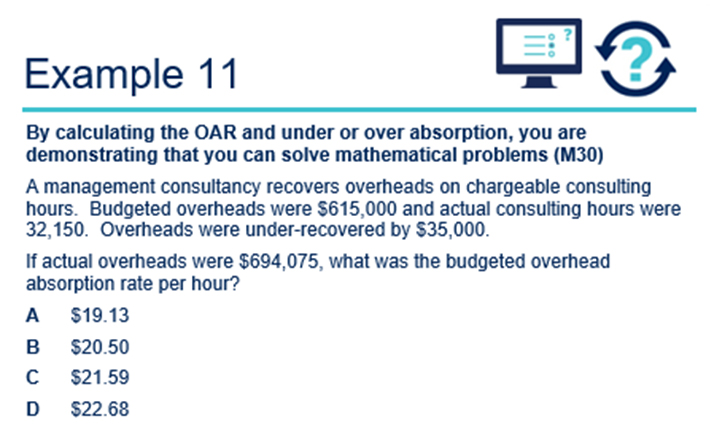
The following question can be found in our Kaplan MA integrated workbook:
The three steps
1. OAR = Budget overheads / Budget activity
2. Absorbed amount = OAR × Actual activity
3. Under or over absorption = Absorbed amount compared to actual cost
If this question you are asked to calculate the OAR and have the following information (put in to the three steps):
1. OAR = $615,000 / Budget activity
2. Absorbed amount = OAR × 32,150 hours
3. Under absorption $35,000 = Absorbed amount compared to actual cost of $694,075.
Starting with Step 3 - as there is an under absorption then overheads absorbed are less than the actual cost therefore deduct the under absorbed amount from the actual overheads. $694,075 - $35,000 = $659,075.
Move to Step 2 and divide the absorbed amount of $659,075 by the actual hours to calculate the OAR. $659,075 / 32,150 hours = $20.50
Correct answer is B
You could have been asked to go one step further and calculate the budget activity. To do this you would have divided the budgeted overhead by the OAR. $615,000 / £20.50 = 614979.5 hours.
Final thoughts
Passing the ACCA MA exam will require a thorough understanding of the theoretical and practical aspects of management accounting. By focusing on key topics, you can effectively prepare for both sections.
Practice example questions under timed exam conditions to help you manage your time wisely, while prioritising Section B before tackling Section A. Additionally, pay close attention to details like absorption rates and their bases to ensure accuracy in your calculations.
With dedication and a strategic approach, success in the ACCA MA exam is achievable and will significantly help you in your career and further studies.
Additional support and resources
If you’re considering progressing your career with the ACCA qualification, give yourself the best chance to pass with four study methods available for the ACCA MA course.
When you study with Kaplan, you can access the Academic Support team via the ‘contact a tutor’ option on your MyKaplan. The team is available seven days a week and can support you with any tricky topics via live chat, email, or by requesting a call back.
And, if you have any additional learning needs, get in touch with our inclusion team, who can support you.
Kaplan Publishing, an ACCA Content Partner, also offers ACCA Study Texts, Exam Kits, and Pocket Notes for each subject in the qualification to help you feel exam confident.
Read our blog for additional tutor tips for other exam subjects.